Blog / June 19, 2026
The Tariff Will Change Again. Your Labels Should Be Ready.
The rate on EU wine has moved three times in a year. Here’s the one part of the import equation you actually control.
By Zillah Bahar, Founder, COLAClear · June 19, 2026
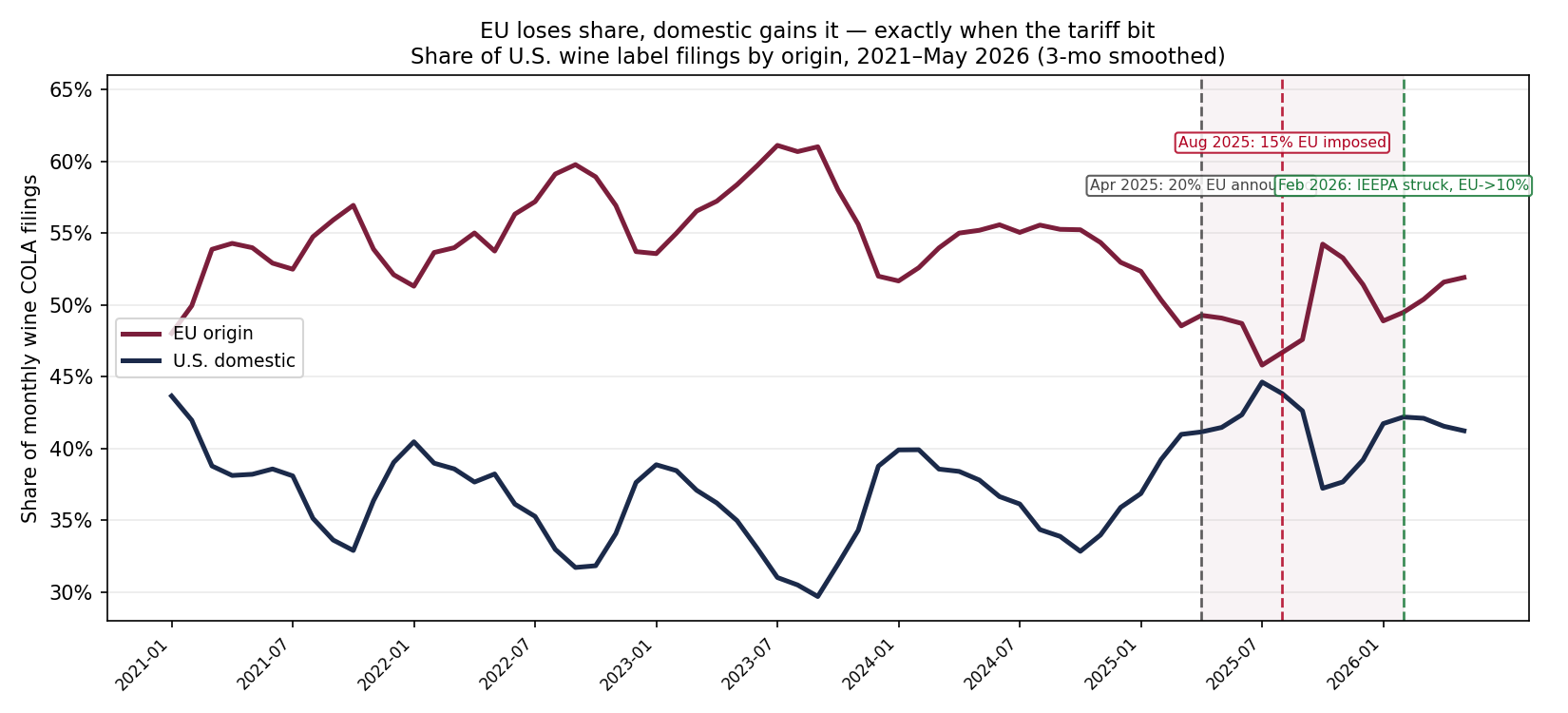
The 10% tariff on EU wine is a placeholder. In barely a year it has gone from 20% to 15% to 10%, switched the law it’s collected under, and now sits on a clock that runs out July 24 — with no settled replacement. You can’t plan around a number that won’t hold still. So here’s the move that’s actually in your control: keep your labels ready.
The federal label data makes the pattern plain. When a tariff bites, most importers go quiet — they stop filing COLAs. When it eases, they scramble to catch up. The ones who kept their approvals current move first. The ones who went dormant are filing from scratch while their competitors load containers.
A COLA isn’t your bottleneck when a window opens — sourcing and freight are. TTB clears a clean wine label in days. The scramble comes when the label isn’t right, or when you’re filing alongside everyone else who also waited. The cheap insurance is to get the labels for the wines you’d actually want to move filed and clean before the rate moves — so a reversal is a green light, not a fire drill.
You can’t predict the tariff. You can decide whether the next change finds your paperwork done or your team scrambling.
Make sure the label clears the first time.
Run it through a free pre-check against the TTB rules before you file — so it’s approved and ready when you need to move.
Pre-check your label free →Zillah Bahar is the founder of COLAClear, a TTB label pre-screening platform for wine, spirits, and beer.
Sources: Filing data — wine COLAs by country of origin, TTB Public COLA Registry (ttbonline.gov). EU tariff timeline — NPR (April 2025), VinePair (August 2025), Holland & Knight (February 2026 Supreme Court ruling); Section 122 expiration via J.M. Rodgers. TTB processing times — TTB.gov.
Related reading: Wine labels have a season — when filings actually move. See also what imported wine labels need that domestic ones don’t.