Blog / May 31, 2026
What Imported Wine Labels Need That Domestic Ones Don’t
The requirements that have nothing to do with what’s in the bottle — and everything to do with the fact that it crossed a border.
By Zillah Bahar, Founder, COLAClear · May 31, 2026
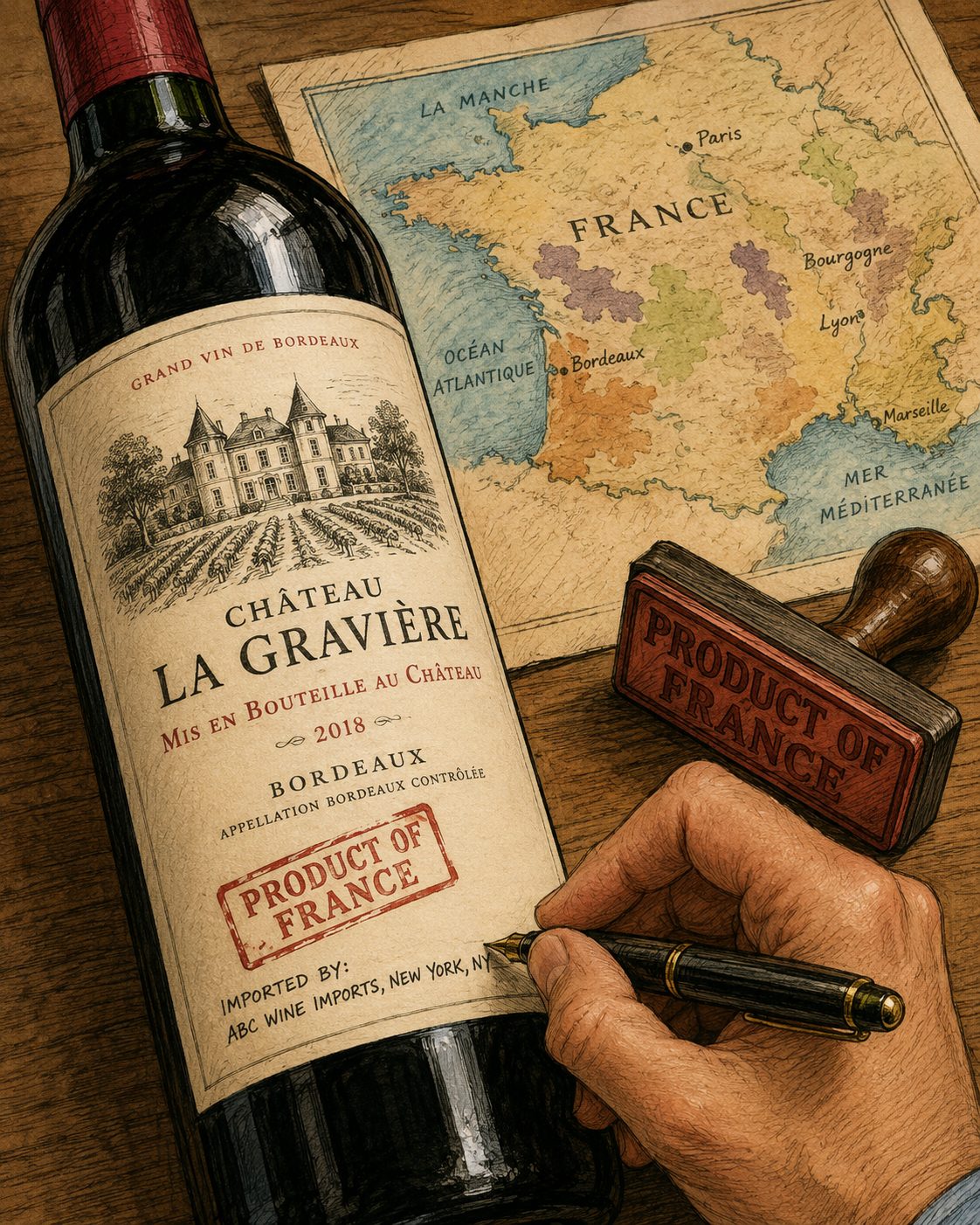
If you import wine, your label carries requirements a domestic winery never has to think about — and they’re easy to miss, because they have nothing to do with what’s in the bottle. They’re about the fact that it crossed a border. Here are the ones that trip importers up.
If one of these already got your label sent back, here’s what a TTB “Needs Correction” means and what to do →
1. Country of origin — and it has to be conspicuous
Every imported wine has to be marked with its country of origin (Product of France, Wine of Italy, and so on). This isn’t even a TTB rule — it’s U.S. Customs (19 CFR 134.11), and it requires the marking to be in a conspicuous place, legible, and permanent. A domestic label never carries this. The common miss isn’t omitting it entirely; it’s burying it in tiny type on the back where Customs or TTB considers it not conspicuous enough.
2. “Imported by” — your name, not the winery’s
A domestic label shows who made or bottled the wine (“Produced by,” “Bottled by”). An imported label has to show the U.S. importer’s name and address, and the words “Imported by” must precede it (27 CFR 4.35). This is you — the importer of record — not the château or the estate. Designers working from the producer’s original label routinely forget that a U.S. importer line even needs to exist.
3. The COLA is yours to hold, not the producer’s
This isn’t on the label, but it’s the part that catches new importers: you are the responsible party. Under the FAA Act, you can’t remove wine of 7% alcohol or more from Customs custody for sale without the Certificate of Label Approval in your possession. The foreign winery doesn’t file it for you and can’t — they don’t hold a U.S. basic permit. The label clears in your name.
4. A certification, for some origins
Also off the label, also easy to overlook: imported wine may need a certification that its production used proper cellar treatment (27 CFR 27.140). Whether you need it depends on where the wine is from — wine from countries that have a wine-practices agreement with the U.S. is generally covered, while wine from countries without one requires the certification before it can enter. It’s paperwork a domestic producer never touches.
And the trap underneath all of it: a foreign label was designed for a different market
The producer’s home-market label was built to satisfy their country’s rules — the AOC, the DOC, their vintage and varietal conventions. None of that automatically satisfies TTB. The appellation, the grape, and the vintage all still have to be truthful and consistent under U.S. rules (27 CFR Part 4), and a label that’s perfectly legal in Bordeaux or Barolo can still come back from TTB. That gap — between a label built for one regulator and submitted to another — is exactly where imported labels fail.
All of which is checkable before you file: the country-of-origin marking, the “Imported by” line, the appellation-and-varietal consistency on the back. COLAClear runs those checks on imported labels, free during beta, at colaclear.com.
Importing wine? The U.S. label has to be right before you file.
Run a free pre-check against the TTB rules to catch what’s missing.
Pre-check your label free →Zillah Bahar is the founder of COLAClear, a TTB label pre-screening platform for wine, spirits, and beer.
Sources: 27 CFR 4.35 (name and address / “Imported by”) · 19 CFR 134.11 (country-of-origin marking, U.S. Customs) · FAA Act (COLA possession requirement) · 27 CFR 27.140 (cellar-treatment certification) · TTB, Labeling Requirements for Imported Wines.
Related reading: The Government Warning statement — the single most common label error, and it applies to your imports too.