Blog / May 7, 2026
The two layers of label clearance — and where pre-screening fits
By Zillah Bahar, Founder
A label clearance engagement typically splits into two layers.
Layer one: interpretive work
Brand names with geographic terms evaluated for misleading representations under 27 CFR 4.39. AVA edge cases against the Part 9 registry. Subjective claims like “Reserve,” “Old Vine,” and “Estate Bottled” — where 4.26 sets out the Estate Bottled requirements but real-world cases turn on whether vineyard ownership and continuous control actually qualify. Applying recent TTB rulings to ambiguous facts. These are judgment calls grounded in regulatory intent and TTB practice, not text-matching. This is where the practice lives.
Layer two: deterministic
Does the Government Health Warning have all five mandatory components in the right order per 27 CFR 16.21? Is the sulfite declaration stated correctly per 4.32(e)? Are multi-varietal percentages disclosed per 4.23(b)? Is the vintage date paired with an appellation per 4.27? Is the proof statement consistent with the ABV declaration per 5.65(a)? These are checks that map directly to fixed regulatory text. They have binary right/wrong answers under the regulations.
If a label has already come back on one of these, here’s what a “Needs Correction” notice means and what to do next →
The split matters because the two layers have different cost structures. Layer one work scales with case complexity — a compliance attorney brings judgment, regulatory experience, and TTB practice insight to bear on a problem that needs interpretation. Layer two work scales linearly with label volume — each label has roughly the same set of deterministic checks, with output that follows the same regulatory text whether it’s done by an associate, a paralegal, or a tool.
Where COLAClear fits
COLAClear automates layer two. The application reads label artwork via OCR, cross-references it against the live text of 27 CFR Parts 4, 5, and 16, and returns 34 compliance checks with a CFR citation on every flag. State coverage extends to California conjunctive labeling requirements (parent-AVA mandates for Napa Valley, Sonoma County, Monterey County sub-AVAs, and Paso Robles) and Oregon’s stricter 90% varietal-percentage rule under OAR 845-010-0915.
The output is structured: each check labeled pass, review, or fail, with the regulatory section it cites and the supporting label text from the artwork. Reports export as PDF.
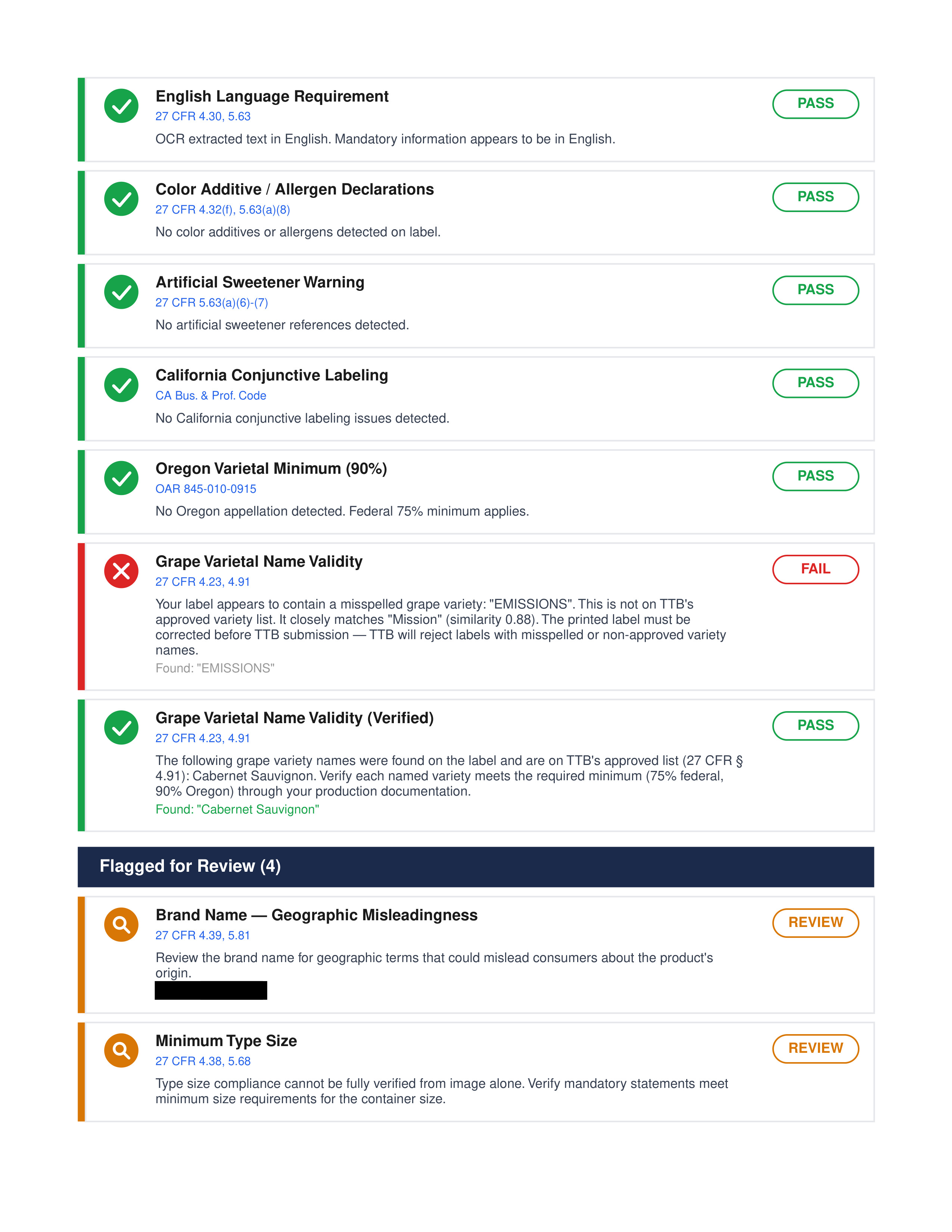
For a compliance practice, the practical use case is straightforward:
- Run the label through COLAClear when an engagement opens
- Use the deterministic findings as the starting point of your review
- Concentrate hours on layer-one work where judgment moves the needle: geographic disputes, brand name positioning, AVA edge cases, regulatory-action defense, multi-product portfolio strategy
- Drop the structured report into the engagement file as documentation
Inputs accepted: JPG, PNG, TIFF, WEBP. Front, back, and optional neck-label support.
What COLAClear does not do
- It does not handle layer-one interpretive work. Brand name misleadingness, AVA edge cases, novel TTB ruling application — these still require attorney judgment.
- It does not submit COLAs to TTB. It is a pre-screening tool, not a filing service.
- It does not constitute legal advice.
- It blocks formula-dependent products (flavored wines and spirits, cordials, liqueurs, RTDs, sake) from the standard checks, with a recommendation to consult a qualified beverage compliance attorney.
- It does not cover malt beverages (27 CFR Part 7) or wines under 7% ABV.
The application is currently in public beta and free to use. Try it at colaclear.com.
See where your label stands on the deterministic checks.
Run your label through a free pre-check against the TTB regulations before you file.
Pre-check your label free →Related reading: 7 reasons TTB issues a “Needs Correction” notice covers the specific errors pre-screening catches. The AVA conjunctive labeling rule walks through one of the most common in depth.